BPMN events
Circles, and the two things about a circle that carry all the meaning: how heavy its border is, and what is drawn inside it. Once those two are separate ideas in your head, the whole event catalogue collapses to a grid.
8 min readBPMN 2.02 of 7
The short answer
- A BPMN event carries two independent facts: its border says where in the flow it sits, its glyph says what kind it is.
- Thin border is a start event, double is intermediate, thick is an end event. Nothing else about the circle changes that.
- An unfilled glyph catches, a filled one throws. The same envelope means wait for a message or send one, decided by the fill alone.
- A boundary event is how BPMN models an exception: interrupting with a solid border cancels the activity, non-interrupting with a dashed one runs beside it.

01Border weight, then glyph#
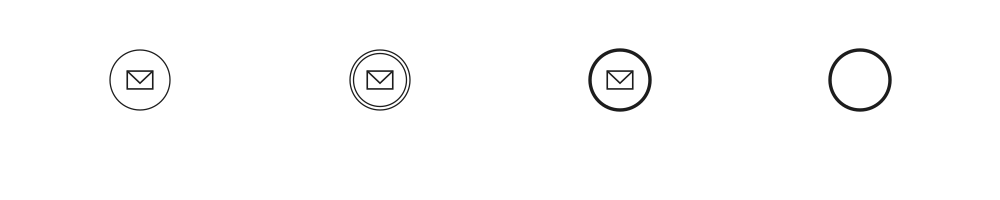
Every BPMN event answers two questions independently, and reading them separately is the whole trick:
| Element | Notation | What it means |
|---|---|---|
| Start event | thin single border | Where a process instance begins. Nothing may flow into it. A process may have more than one, and each is a separate way in. |
| Intermediate event | double border | Something that happens during the process - either waited for, or raised. Sits in a sequence flow, or on the boundary of an activity. |
| End event | thick single border | Where this path finishes. Nothing may flow out of it. Reaching one ends that token, not necessarily the whole process. |
| Interior glyph | envelope, clock, bolt | Which kind of thing happened. Empty means "none" - unspecified, and perfectly respectable on a descriptive model. |
02The event types worth knowing#
| Element | Notation | What it means |
|---|---|---|
| None | empty circle | Unspecified. The right choice on a descriptive model where "the process starts" is all anyone needs. |
| Message | envelope | Something arrived from, or is sent to, another participant. Always paired with a message flow crossing a pool boundary. |
| Timer | clock | A date, a duration, or a cycle. As a start event it is the schedule; on a boundary it is a deadline. |
| Error | lightning bolt | A named failure. Thrown by an end event inside a sub-process, caught by a boundary event on it. This is BPMN's try/catch. |
| Signal | triangle | A broadcast. Unlike a message it has no specific recipient - everybody listening reacts. |
| Conditional | lined page | Fires when a condition on the data becomes true, not when a step ends. |
| Escalation | upward arrow | Like an error, but the activity carries on. "Tell someone senior and keep going." |
| Terminate | filled circle | End event that kills every token in the process instance, not just its own. The one end event with teeth. |
Eight of thirteen. Compensation, cancel, link and multiple exist and are rare enough to look up when you meet them.
03Boundary events, or: everything that goes wrong#
A boundary event is an intermediate event drawn on the edge of an activity, and it is the most useful construct in BPMN. It says: while this task is running, this other thing might happen, and if it does, leave here instead.
Timeouts, cancellations, errors, a customer phoning to change their order - all of them are a boundary event, and all of them would otherwise need a gateway and a second path that the reader has to mentally interleave with the first.
| Element | Notation | What it means |
|---|---|---|
| Interrupting | solid double border | The activity is cancelled and the token leaves by the boundary. A timeout, an error, a cancellation. |
| Non-interrupting | dashed double border | The activity carries on and a second token starts down the boundary path. An escalation, a status enquiry, a reminder. |
04Start and end events in practice#
A process with several start events has several genuinely separate ways in - a claim arriving by post, by app, and by phone. That is usually clearer than one start event followed by a gateway asking how it arrived, because the gateway implies the channel is a decision the process makes, when it is a fact the process is handed.
End events are the reverse: several are usually right, because the name of the end event is the outcome. "Claim settled" and "Claim rejected" as two end events tell you more than one "End" with a gateway in front of it. Process reporting later counts exactly these, so naming them well pays twice.
Reach for it when
- Several start events when there are genuinely several triggers
- Several end events, each named for the outcome it represents
- A terminate end event when one path failing must stop everything
- Boundary events for every exception you can name
Reach for something else when
- An empty 'End' after a gateway that already decided the outcome
- An intermediate none event used as a milestone marker - use a text annotation
- A message start event with no message flow drawn into it
- Boundary events on a task that cannot plausibly be interrupted
05Common mistakes#
- Sequence flow out of an end event. Nothing follows an end event. Ever. If something does, it was an intermediate event.
- A message event with no message flow. The glyph claims another participant exists; draw the pool and the flow, or use a none event.
- Throwing and catching confused. Hollow waits, filled sends. Getting it backwards inverts the direction of the whole conversation.
- Timer events used as delays that are really queues."Wait 2 days" usually means "this sits in somebody's inbox". Model the task and put the timer on its boundary.
- One end event for everything. The outcomes disappear, and so does the reporting.
Events pair naturally with gateways: an event-based gateway is precisely a race between several catching events, and it is the construct that makes "whichever comes first" expressible.
In one line each
- 01Border weight says when - thin starts, double happens during, thick ends.
- 02Interior glyph says what kind; empty is a legitimate answer.
- 03Hollow glyphs catch, filled glyphs throw.
- 04A boundary event is how BPMN says "and if this goes wrong".
- 05Interrupting cancels the activity; non-interrupting runs beside it.
- 06Name end events after outcomes - they become your process reporting.
06Common questions#
What do the different BPMN event borders mean?
Border weight carries the position in the flow. A thin single line is a start event, a double line is intermediate, and a thick single line is an end event. The glyph inside carries the type, so border and glyph are two independent choices.
What is the difference between a throwing and a catching event?
A catching event waits for something to happen and has an unfilled glyph. A throwing event makes it happen and has a filled, solid glyph. The same envelope symbol therefore means wait for a message when unfilled and send a message when filled.
What is a boundary event in BPMN?
An intermediate event attached to the edge of an activity, catching something that happens while that activity is running: a timeout, an error, a cancellation message. It is how BPMN models exceptions without a separate error-handling diagram.
What is the difference between an interrupting and a non-interrupting boundary event?
An interrupting boundary event has a solid border and cancels the activity it is attached to when it fires. A non-interrupting one has a dashed border and starts a parallel path while the activity carries on, which is how an escalation notice is modelled.
What are the most common BPMN event types?
Message, timer, error, signal and conditional cover most real diagrams. Message and timer alone cover the majority of them: something arrived, or enough time passed.
In this series
Related reading
Foundations
Notation reference
Behaviour diagrams
Notation reference
Modelling practice
Modelling practice