The ArchiMate layers
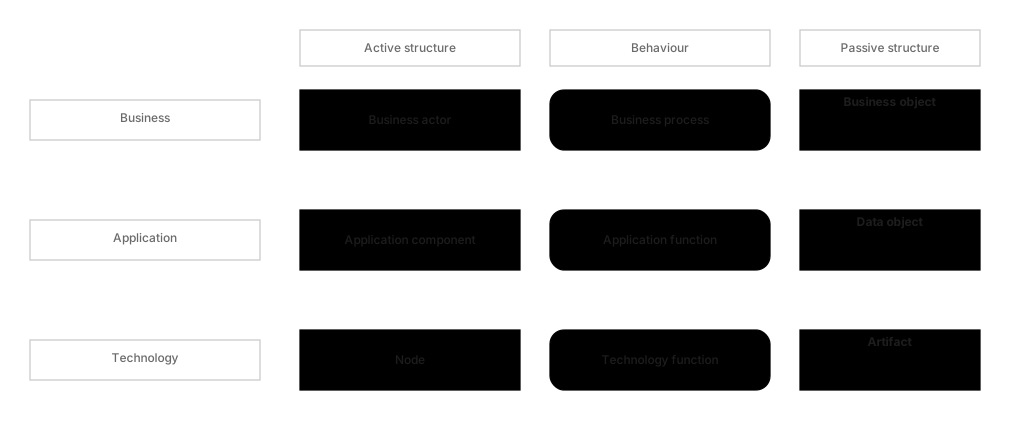
Six layers and three aspects. Between them they place every element type in the language, which means the grid is not a summary of ArchiMate - it is most of ArchiMate.
9 min readArchiMate 42 of 5
The short answer
- Six layers and three aspects. The grid they form places almost every element type in the language, so the grid is most of ArchiMate rather than a summary of it.
- Business, application and technology are the core three. Strategy sits above, physical extends technology, implementation covers the programme between two states.
- Active structure, behaviour, passive structure: the who, the what happens, and the what it happens to.
- Layers connect through services. An application component is the thing that does the work; the application service is what it offers outwards.
01Why it is a grid#
Most languages hand you a list of element types to memorise. ArchiMate hands you two short lists and a multiplication. Six layers, three aspects, and the promise that a cell means the same thing in every row: a service is a behaviour element that some other element realizes and that serves something above it, whether it is a business service, an application service or a technology service.
That regularity is worth leaning on hard while learning. If you know what an application component is, you know what a node is - the same cell one layer down. If you know a business process is assigned from a business role, you know a technology process is assigned from a node.
02The three aspects#
| Element | Notation | What it means |
|---|---|---|
| Active structure | square-cornered rectangle | Something that can do things. Business actor and role, application component, node, device. It performs behaviour; it never is behaviour. |
| Behaviour | rounded rectangle | Something being done. Process, function, interaction, event, service. This is where the verbs live. |
| Passive structure | rectangle with a top band | Something behaviour acts upon. Business object, contract, data object, artifact, material. |
The three come with a grammar that is worth learning as a sentence: active structure is assigned to behaviour, behaviour accesses passive structure, behaviour serves other behaviour. Nearly every well-formed ArchiMate model is that sentence repeated. If a line in your model does not fit one of those three shapes, look at it twice.
03The three core layers#
Business.The organisation described in its own words: actors and the roles they play, the processes they run, the services customers consume, the objects those processes handle. The test for whether something belongs here is whether a non-technical colleague would recognise the name. "Claims handling" passes; "ClaimServiceImpl" does not.
Application. The software. A component is a deployable, replaceable piece of software - the same idea as a UML component, at coarser grain. An application service is what that software offers to the business layer, named as a capability rather than as an endpoint: "claim registration", not POST /claims.
Technology.What the software runs on. Nodes, devices, system software, networks, and the artifacts (binaries, images, files) deployed onto them. In a cloud estate a node is usually a service or a cluster rather than a machine, and that is fine - a node is "a computational resource", which a managed database certainly is.
04Strategy, physical, implementation#
The other three layers are used less often and are worth knowing exist, because reaching for a business process when you meant a capability produces a model that argues with itself.
| Element | Notation | What it means |
|---|---|---|
| Strategy | resource, capability, course of action, value stream | What the organisation is ableto do, deliberately independent of how. "Claims processing" is a capability; "claims handling" is the process that currently realizes it. Swapping the process leaves the capability standing, and that is exactly the point. |
| Physical | equipment, facility, distribution network, material | The technology layer for things that are not computers. Manufacturing lines, warehouses, vehicles, raw material. Ignorable in a pure software estate, indispensable in logistics or utilities. |
| Implementation | work package, deliverable, implementation event, plateau, gap | How you get from the current architecture to the intended one. A plateau is a state the architecture rests at; a gap is what is missing between two of them. This is the layer that turns a model into a roadmap. |
Plateaus are the underrated one.Two plateaus - "today" and "after the migration" - each aggregating the elements valid in that state, give you a before-and-after architecture in one model rather than two files that drift apart. The gap between them is a first-class element you can attach work packages to.
05Motivation cuts across everything#

Motivation elements are not a layer under technology - they attach to elements anywhere in the model, and they answer the question no other layer can: why is the architecture shaped like this?
| Element | Notation | What it means |
|---|---|---|
| Stakeholder | a role with an interest | Someone whose opinion of the architecture matters. Usually a role. |
| Driver | a steering wheel glyph | Something creating pressure to change. Cost, regulation, competition. |
| Assessment | a magnifier glyph | A finding about a driver. The evidence, dated and specific. |
| Goal | a target glyph | An intended end state, stated so you could tell whether you got there. |
| Outcome | a hit target | A result actually achieved. The past tense of a goal. |
| Requirement | Something the system must do to realize a goal. Realization is the relationship that connects the two. | |
| Principle | same glyph as requirement | A rule that applies to the whole architecture rather than one system. |
| Constraint | same glyph again | A restriction on how a goal may be realized, not on what it is. |
Influence is the relationship that only motivation uses, and it is deliberately weaker than the rest: it says the source affects the target without claiming how much or in which direction. It can carry a +, -, or a weight, which is how you say that one goal helps a driver and another one hurts it.
06How much of this to use#
Reach for it when
- Business, application and technology - almost every model needs these three
- Motivation, as soon as anyone will ask why in six months
- Strategy, when the conversation is about capability rather than systems
- Implementation, when the deliverable is a roadmap and not a snapshot
Reach for something else when
- Physical, unless the organisation moves atoms as well as bits
- Every layer at once in one view - split by viewpoint instead
- Strategy as a synonym for business - a capability is not a process
- Motivation as a place to paste the requirements document
A first useful model is usually three layers and a handful of motivation elements. The other three layers are there when the question needs them, and a model that uses all six is either a genuinely large enterprise or a model nobody will maintain.
In one line each
- 01Six layers times three aspects places every element type in the language.
- 02Active structure does, behaviour is done, passive structure is acted upon.
- 03Square corners, rounded corners and a top band are the three outlines that say which.
- 04A service is behaviour - a rounded box - not the component that offers it.
- 05Strategy is capability, business is process; they are different layers on purpose.
- 06Motivation attaches anywhere and is the only layer that records why.
07Common questions#
What are the ArchiMate layers?
Strategy, business, application, technology, physical, and implementation and migration. Business, application and technology are the core three that most models use. Strategy sits above them, physical extends technology to equipment and materials, and implementation covers the programme that gets you from one state to the next.
What are the three ArchiMate aspects?
Active structure, behaviour and passive structure: the who, the what happens, and the what it happens to. Crossed with the layers they form the grid that places almost every element type in the language, which is why the grid is most of ArchiMate rather than a summary of it.
Where do motivation elements fit?
They cut across every layer rather than sitting in one. Stakeholder, driver, assessment, goal, outcome, principle, requirement and constraint answer why the architecture is the way it is, and can attach to elements in any layer.
What is the difference between an application component and an application service?
The component is active structure: the thing that exists and does the work. The service is behaviour exposed to something else: what the component offers outwards. Layers connect to each other through services, so getting this distinction right is what keeps a layered view readable.
In this series
- 01What is ArchiMate
- 02Layers and aspects
- 03Relationships
- 04Viewpoints
- 05ArchiMate with AI
Related reading
Foundations
Notation reference
Modelling practice
Structure diagrams
Modelling practice