UML profile diagrams
How to extend UML itself. Stereotypes, tagged values, and the extension arrow - the mechanism behind every «entity», «service» and «microservice» you have ever seen on a diagram.
6 min readUML 2.5.130 of 35
The short answer
- Every guillemet you have ever seen on a diagram - entity, service, microservice - was defined by a profile somewhere.
- Stereotypes add meaning; tagged values add data. A service stereotype defining an SLA tag lets a component carry a concrete SLA.
- The extension arrow is what binds a stereotype to one metaclass. Extending Class means it applies to classes and to nothing else.
- Define a profile when you want tools to act on an annotation. A note is invisible to every tool; a stereotype is part of the model.

01What it shows#
A profile diagram is UML describing an extension to itself. It is the only diagram in the language whose subject is the language, which is why it feels different from the other thirteen and why most people never draw one.
You have almost certainly used the result. Every time you have seen «entity», «service», «controller», or «microservice» on a class box, you were looking at an applied stereotype. A profile diagram is where that stereotype is defined: what it is called, what it can be attached to, and what extra properties it carries.
02The notation#
| Element | Notation | What it means |
|---|---|---|
| Metaclass | box, «metaclass» | An element of UML itself - Class, Component, Association. What you are extending. |
| Stereotype | box, «stereotype» | The new concept you are adding to the language. |
| Extension | Solid line, filledtriangle at the metaclass. "This stereotype may be applied to that kind of element." | |
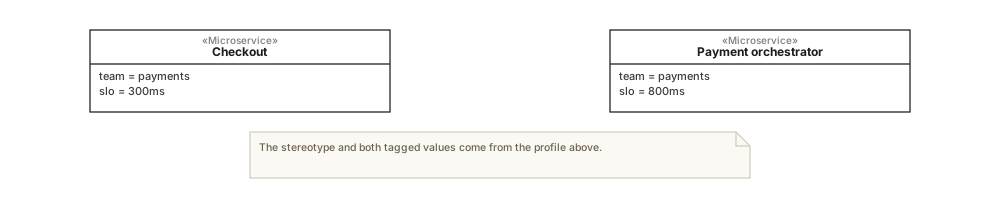
| Tagged value | an attribute on the stereotype | An extra property that applying the stereotype gives you - slo: Duration. |
| Profile | package, «profile» | The package that groups a set of stereotypes so they can be applied together. |
| «apply» | From a package to a profile: everything in here may use those stereotypes. |
03When you actually need one#
Be honest about the threshold. Using a stereotype needs no profile at all - «entity» on a box communicates perfectly well to a human reader without anything being formally defined. You need a profile diagram when the stereotype has to mean something to a machine.
That happens in three situations. When a tool must validate the model - refusing to apply «microservice» to an association, or requiring that every one of them declares an SLO. When code or documents are generated from the model, and the generator branches on the stereotype. And when a whole industry has agreed on a vocabulary: SysML, MARTE, SoaML and the like are all UML profiles, and they are the main reason the mechanism exists.
04Keeping a profile useful#
Reach for it when
- A tool has to validate or generate from the stereotype, not just display it
- You need extra structured data on model elements - owner, SLO, classification
- Adopting a standard profile such as SysML that somebody else has already defined
- The same handful of domain concepts recur across many diagrams and teams
Reach for something else when
- One or two stereotypes used purely as visual labels - just write them
- The concepts you are adding already exist in ArchiMate or another language
- Nobody will maintain the profile after the person who wrote it moves on
- You are extending UML to avoid learning the part of UML that already covers it
A good profile is small. Five to ten stereotypes, each with an obvious meaning and at most a couple of tagged values, applied consistently, is worth far more than forty that nobody can remember. And every tagged value you add is a field somebody has to fill in on every element, forever - so make each one earn its place.
One practical warning about portability: profiles are the part of UML that travels worst between tools. Stereotype definitions survive an XMI round-trip much less reliably than plain model elements do, and tagged values often arrive as untyped strings or not at all. If your model has to move between tools, keep the profile as small as you can bear.
In one line each
- 01The only UML diagram whose subject is UML itself.
- 02A stereotype extends a metaclass; the arrow is a solid line with a FILLED triangle.
- 03Generalization's hollow triangle means something different and is the usual mistake.
- 04Tagged values are extra properties that applying the stereotype provides.
- 05You need a formal profile only when a tool must act on the stereotype.
- 06Keep profiles small - they are also the part of a model that exports least reliably.
05Common questions#
What is a stereotype in UML?
A named extension of an existing UML element, written in guillemets: entity, service, controller. It lets you specialise the language for a domain without inventing new notation, and every one you have seen was defined by a profile somewhere.
What is a tagged value?
A property added to an element by a stereotype. A service stereotype might define an SLA tag; applying it to a component lets that component carry a concrete SLA value. Tagged values are how a profile adds data, as stereotypes are how it adds meaning.
What is the extension relationship?
The arrow from a stereotype to the metaclass it extends, drawn as a solid line with a filled triangle. It is what makes a stereotype applicable to one particular kind of element: extending Class means it can be applied to classes and to nothing else.
When should I define a profile instead of using notes?
When the same annotation appears often enough that you want tools to act on it: validate it, filter by it, or transform it on export. A note is invisible to every tool; a stereotype is a first-class part of the model.
In this series
- 01What is UML?
- 02UML symbols
- 03Choosing a diagram
- 04Class diagrams
- 05Class diagram examples
- 06How to draw a class diagram
- 07Class diagram symbols
- 08Sequence diagrams
- 09Sequence diagram examples
- 10How to draw a sequence diagram
- 11Use case diagrams
- 12Use case examples
- 13Activity diagrams
- 14Activity examples
- 15State machine diagrams
- 16State machine examples
- 17Component diagrams
- 18Component examples
- 19Drawing a component diagram
- 20Component symbols
- 21Deployment diagrams
- 22Deployment examples
- 23Object diagrams
- 24Package diagrams
- 25Composite structure diagrams
- 26Communication diagrams
- 27Sequence vs communication
- 28Timing diagrams
- 29Interaction overview diagrams
- 30Profile diagrams
- 31UML with AI
- 32E-commerce example
- 33Banking example
- 34Microservices example
- 35AWS example
Related reading
Foundations
Structure diagrams
Structure diagrams
Structure diagrams
Modelling practice
Behaviour diagrams