How to draw a UML class diagram
Five steps in the order that works: find the nouns, draw the lines, decide the multiplicities, then attributes, then operations - and stop when it answers the question.
7 min readUML 2.5.16 of 35
The short answer
- Classes, then relationships, then multiplicities, then attributes, then operations. Attributes feel like the start and are the worst one.
- A noun becomes a class when it has identity, changing state and a lifetime of its own. A colour or an amount is an attribute.
- It is finished when it answers the question it was drawn for and every relationship on it carries a multiplicity.
- Not when every class appears and not when every attribute is listed - a diagram reaches both of those while still answering nothing.
01Steps one and two: the nouns, then the lines#
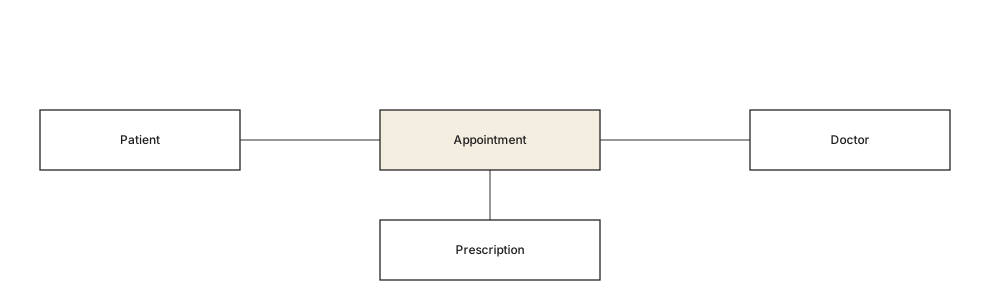
Step one is to write down how the domain is described out loud and underline the nouns. "A patient books an appointment with a doctor, and the doctor may issue a prescription" gives four candidates immediately. Keep the ones with three properties: identity (two of them can be distinguished), state that changes over time, and a lifetime of their own. A noun failing all three - a colour, an amount, a status - is an attribute of something else.
Step two is one line per sentence you can say about the domain. Not per database join, and not per method call: a line means the two classes know about each other in the business sense. The diagram above is where that ends, and it is already worth putting in front of somebody who knows the domain, because the argument you want is about whether a prescription belongs to an appointment or to a patient - and that argument is available now, before any attribute has been typed.
02Step three: the multiplicities, before anything else#
Every line gets a number at each end before a single attribute is added. This is the step people skip and the one that pays, because a multiplicity is a decision about what the system permits and an attribute is a detail that follows from it.
Read each end as a sentence and say it aloud. "One patient has zero or more appointments" - fine. "One appointment has exactly one patient" - fine, and worth checking, because a clinic that ever books a family slot has just told you otherwise. The three questions to ask at every end are: can it be zero, can it be more than one, and does that change on a bad day?
Then pick the relationship kind, and there are only two decisions worth agonising over. Is the part deleted with the whole - if yes, composition. Does something hold the parent type without caring which subtype - if yes, generalization. Everything else is a plain association, and the worked examples show both calls being made.
03Steps four and five: attributes, operations, and stopping#

Attributes come fourth and each one has to have a source. If you cannot say where a value comes from - a form, another system, a calculation - it is a guess, and guesses are what make a model stop matching the thing it describes. Types are worth writing: startsAt: Instant settles an argument that startsAt: Date leaves open.
Operations come fifth and most classes get none. An operation belongs on a class when the behaviour genuinely needs that class's own state to work - cancel() needs the appointment's status, so it belongs. Anything that needs three other objects to do its job is a service, and putting it here is how a domain model quietly becomes a diagram of the code instead of a diagram of the domain.
Then stop. The finished diagram above has four classes and answers a question; adding Clinic, Room, Invoice and Insurer would make it more complete and less useful. If a second question needs answering, draw a second view over the same model - that is what views are for.
In one line each
- 01Nouns with identity, changing state and their own lifetime become classes. The rest are attributes.
- 02Draw the lines before the attributes, and show the ugly version - it is the one people correct.
- 03Decide multiplicities third, out loud, asking whether each end can be zero or more than one.
- 04Every attribute needs a source. Types settle arguments that names leave open.
- 05Stop when the question is answered, not when the system is fully drawn.
04Common questions#
How do I decide what becomes a class?
Take the nouns from how the domain is described out loud and keep the ones that have identity, state that changes, and a lifetime of their own. A noun that is only ever a value of something else, like a colour or an amount, is an attribute rather than a class.
What order should I draw a class diagram in?
Classes, then relationships, then multiplicities, then attributes, then operations. Attributes feel like the obvious starting point and are the worst one, because they are the part most likely to be thrown away once the relationships force a rethink of what belongs where.
When is a class diagram finished?
When it answers the question it was drawn for and every relationship on it carries a multiplicity. Not when every class in the system appears on it, and not when every attribute is listed - both of those are states a diagram can reach while still answering nothing.
In this series
- 01What is UML?
- 02UML symbols
- 03Choosing a diagram
- 04Class diagrams
- 05Class diagram examples
- 06How to draw a class diagram
- 07Class diagram symbols
- 08Sequence diagrams
- 09Sequence diagram examples
- 10How to draw a sequence diagram
- 11Use case diagrams
- 12Use case examples
- 13Activity diagrams
- 14Activity examples
- 15State machine diagrams
- 16State machine examples
- 17Component diagrams
- 18Component examples
- 19Drawing a component diagram
- 20Component symbols
- 21Deployment diagrams
- 22Deployment examples
- 23Object diagrams
- 24Package diagrams
- 25Composite structure diagrams
- 26Communication diagrams
- 27Sequence vs communication
- 28Timing diagrams
- 29Interaction overview diagrams
- 30Profile diagrams
- 31UML with AI
- 32E-commerce example
- 33Banking example
- 34Microservices example
- 35AWS example
Related reading
Structure diagrams
Structure diagrams
Notation reference
Modelling practice
Modelling practice
Behaviour diagrams